To Hen Blog Archive 2008
I'd love to hear from you! Email Terry at terry@terrygolson.com
Chicken Presents
December 23, 2007
A very merry Christmas to all of my Hencam friends who celebrate the holiday!
On Christmas eve I am giving the girls a special wreath made out of kale and apples - food being the one thing that I know they have all asked Santa for (well, in all honesty, that's just about all they ever ask for.)
If you watch Hencam tomorrow, you'll see their present. I took a wild bird suet feeder, filled it with apples, and circled it with kale and parsley. If you catch Hencam a little later in the week (or, probably an hour after hanging the wreath in the morning), it will be a mess - though still enjoyed by the hens. That's one nice thing about chickens - they are so easy to please.
Dark leafy greens are an especially healthy treat for chickens, especially in the winter. Years ago, the small-scale farmer would have owned a special hand-grinder to shred vegetables into bite-sized bits to feed their hens. I could chop up the veggies - but putting them out whole gives the girls something to keep them busy.
I'll be taking a short blogging break until after the New Year. Happy and safe holidays to all!
Molting
December 18, 2007
This is what a chicken looks like when she molts:
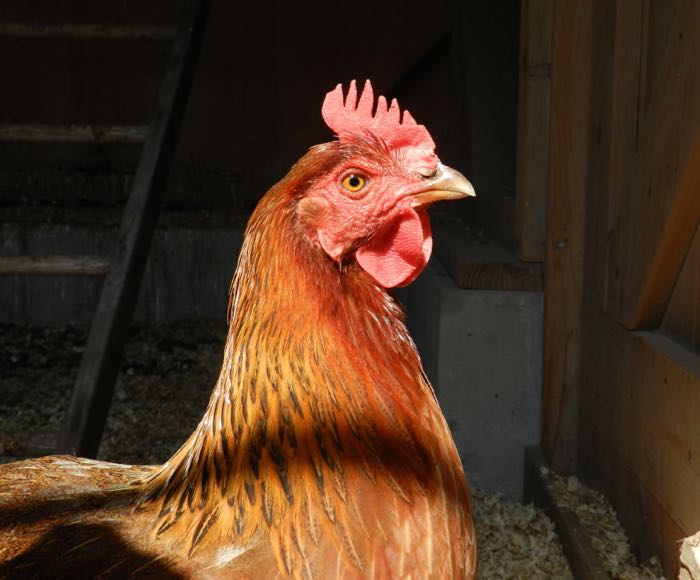
Not a pretty sight, is it? If you don't recognize her, this is Ginger (check the bios page.) Right now her tail is a stump, she's got loose old feathers falling out, and her head looks like it belongs to a vulture. Look close, though and you can see quills, which will turn into new, shiny, full feathers.
A chicken molts once a year. During the molt, not only does the hen have a "bad hair day," but she also stops laying eggs. All of her body's nutrients are put into making new feathers. The molt lasts anywhere from a month to two, depending on the chicken. This is a problem for commercial growers, who sometimes induce the molt by starving the entire flock. Not here. The girls look awful, but are getting a rest from egg laying. By the time there's enough sunlight to turn their bodies' clocks back to laying mode, they're back in full-feather and looking fine.
I do feel badly for Ginger, though. It was only 4 degrees F. this morning, and she doesn't have her full-insulating down coat on. But, she seemed fine. She lives in a snug coop, and can huddle with the other hens at night.
Ginger is a hen that loves to have her picture taken. She poses, she stares, she gets right up to the lens. Today, though, she scurried away from me. Perhaps she knows how she looks?
Books for Gift Giving
December 12, 2007
If it's been awhile since you checked out my chicken keeping Web site, go take a look. I've added another book to the books for children section. I think that childrens' books make great gifts, even for adults. In fact, I gave my husband How the Ladies Stopped the Wind, for Hanukkah this year. How could I resist when it has this refrain: "It was the chickens' job to make fertizlizer for the trees. They did their job very well."
Freezing Rain
December 10, 2007
It looks like just a dreary day outside, but actually the weather is horrid. There is a misty drizzle coming down, but the temperature is 31 degrees F - so as soon as the rain hits the ground, it freezes. There's a thin sheen of ice on the snow, on the paths, on the driveway, and even on the perches in the outside run. It 's treacherous! This morning I put down hay for the girls, so that they have secure footing outside.
I get a lot of questions about how to take care of chickens in the winter, and it is usually easier than people think. I've got winter-hardy breeds, and all they need is a dry house that is free of drafts, and good food and clear water always available. People who own frizzles, Polish, and silkies use heat lamps because those breeds have feathers that don't insulate as well. No chicken can handle being wet and cold. Most chickens know enough to come in before they get soaked, but once in awhile you have that bird who seems more bird-brained than the rest. On days like this, I keep an eye out.
Meet Mazie and LuLu
December 4, 2007
The two new hens have settled right into their new flock. Just as I thought, the Wyandottes became immediate pals. Alma is the golden-laced (who was previously in the HenCam barn) and Mazie is the silver-laced. Wyandottes are an old American breed. They have rose combs (contrast their bumpy low comb to the upright one on Snowball) and are winter hardy, good layers, and active but not aggressive.
I've named the other new hen LuLu. She is a Sussex - the breed is named for where they were developed - Sussex, England. She has yet to find a best friend. But, not all chickens do. Buffy, at the bottom of the totem pole, is at the fringes of flock life. Snowball, is one of the top dogs (to mix metaphors), but she doesn't care and goes about her life without interacting much with the other hens. It's too early to see where LuLu will fit in. But, isn't she simply stunning? Notice the creamy white legs (compare to the Wyandottes' yellow shanks.) LuLu has just reached maturity. I can't wait to see what her eggs look like.
No, You're Not Seeing Double
December 3, 2007
Yes, there really are two big black hens in the coop. Twinkydink has rejoined the flock. You can easily tell the difference between Twinkydink and Blackie - Twinkydink has recently molted and she has a stump of a tail. Look closely and you'll see the new feathers growing in, right now they look like quills.
Alma has been moved over to the new barn because I have two new hens! One of them is a Silver-Laced Wyandotte. For some unknown reason (which I would love to be able to research, or is anyone out there in need of a phD thesis?) hens tend to make friends with hens of their own breeds - even if they haven't been raised with same-looking hens or ever met their mothers (interesting, isn't it?) So, I thought the new Wyandotte and Alma should be together. And Blackie and Twinkydink are happy to see each other again.
The other new hen is a gorgeous Sussex. Stunningly beautiful. Photos will be posted soon.
The two new birds came from a friend in town who had raised 15 chicks for a children's educational program, but doesn't want to keep the hens over the winter. He offered them to our chicken group here in town and we've divvied them up between us.
We are having typical early-December New England weather. Snow, and then light freezing rain. Candy the rabbit and Scooter the puppy are ecstatic. The hens are annoyed. My ten-year old son is throwing snowballs with a friend. I think I'll go warm up a piece of pie.
My Thanksgiving Tradition
November 28, 2007
I love Thanksgiving - I love the traditional meal (the roast turkey, the peas, the potatoes, the stuffing, the pumpkin pie) - and I love having family gathered around a dining room table. But, like for many others, the holiday fantasy doesn't fit the reality. We don't have family to fill our dining room. In previous years, I've had friends over, but once they married and had kids, their in-laws fought over them, and they couldn't come here. I've made the Thanksgiving feast for just the four of us (me, husband and two boys) and, honestly, they couldn't care less about the formal meal.
We've gone away to inns and been the "orphan" family at friends, but it just didn't satisfy my craving for a food and family filled house. So, I created my own Thanksgiving tradition - The Sunday after Thanksgiving Pie Party.
When everyone else is done with their family dramas and travels and don't want to eat another bite of turkey, they come here and eat pie. There's always room for pie. I love making pie, and for this party I make many, many pies. Everything but pumpkin. This year I made: Chocolate Peanut Butter Pie, Raspberry Framboise Tart, Key Lime Pie with Blueberry Glaze, Lemon Chess Pie with Strawberry Topping, Chocolate Cream Pie with Marscapone Whipped Cream, Brownie Pie, Chocolate Chip Cookie Pie, Cherry and Cranberry Peek-a-Boo Pie, Lemon Meringue Pie, Apple and Pear Pie, and Apple Pie with a Nut-Streusel Top.
We ate. We drank coffee. We chatted. We cooed at a baby. We watched the little ones build legos. We chatted. We ate some more. It was the perfect Thanksgiving.
Technical Difficulties
November 27, 2007
You've probably noticed that we've been haven't been up and running here at HenCam (and if you haven't noticed, then you've managed not to become addicted to watching the girls...yet.) We (actually it's more "my husband" than "we") go to great lengths to keep HenCam on the Web. There's a very expensive dedicated line and all sorts of wires and equipment and software. Lately, my husband has been having conversations with people at Verizon (the phone company) and we've met several linemen, and he's chatted with Covad folks out in Colorado. Anyway, not to bore you with it, but do understand that we live on a street that sees frequent phone outages. The repairmen come and shake their heads and say things like, "I've never seen a phone line that old," or, simply, "squirrels." We think the problem has been resolved and thanks for your patience.
Tyson Foods
November 21, 2007
I subscribe to a poultry industry e-newsletter that provides a daily list of pertinent worldwide articles. What people who buy a dozen eggs a week, or a broiler a few times a month, don't realize is how huge, international and powerful this industry is. This newsletter gives a window into that world.
But, despite the incredible volume of poultry products on the global market, it's organic poultry that is getting a premium price. The other segments of the industry have miniscule profit margins - they make their money by selling on a huge scale. Also, it's hard to develop brand recognition in the supermarket. Chickens and eggs really do look alike. So, the big producers want a part of that organic pie - they want high profits and high volume and they think the key to that is to tap into the organic market.
Tyson Foods wants to be able to charge more for their chickens. So, they went to the USDA and got a label approved for a chicken raised without antibiotics. They've spent tens of millions of dollars promoting their new line. They've got big plans for introducing prepared foods using it.
Then, someone at the USDA blew the whistle. Tyson uses an "antimicrobial" feed additive. They say it's not an "antibiotic." Tyson thinks the issue will be resolved soon and they can go on making the American housewife feel that she is a hero to her family for buying such a pure, clean food. (I'm paraphrasing - but that's what the Tyson ads are touting.)
The American public hasn't gotten wind of this yet. But, when they do, once again, the consumer will become wary and jaded. They won't believe anyone's claims. Which will leave the small producer who is truly raising a good product, yet again having to convince the public that their poultry and eggs really are different. The consumer needs to do more than pick up a package because it says "no anitibiotics" or even "organic," but that's too much work for most harried customers. The PR job will be left to each small farmer, and that's a hard job (when farming is hard and time-consuming enough!)
To read the full text of the article go here. Scroll down until you find the Tyson Told it Can't Use Raised Without Antibiotics Label.
Enjoy your Thanksgiving turkey (that is, my American HenBlog readers who celebrate this national eating fest.) And for those of you with poultry in your backyards, especially the lucky ones who have some big bronze turkeys strutting about, toss them an extra handful of corn for me.
My Thanksgiving celebration involves pie. A lot of pie. More on that in my next blog.
High Style in the Coop
November 20, 2007
Yes, you can be chic with the chicks (ouch, sorry!!) We all need a pair or two of muck/mud boots. Right now, colorful rubber boots are in. Last weekend, I was in Cambridge, MA (the hometown of Harvard University), which not only believes that it is the hub of the universe, but also the center of hip. One of the trendy shoe shops in the Square had a display of rubber boots right in the window. I'm probably the only buyer of these polka-dot beauties that's actually going to wear it somewhere other than walking on pavement. My hens, my ever-appreciative audience, think that they look great!
Egg Coddler
November 14, 2007
I bought this kitchen item at a flea market, and had hopes of making beautiful daisy-like coddled eggs. A coddled egg is simply an egg that is cracked into a mold and set over simmering water. Rather like a hard-cooked egg (or soft-boiled) without the shell. (Coddled eggs differ than poached, in that the poached are submerged in water.)
But I need help! This coddler was made in England by the Nutbrown Company. Perhaps one of my HenCam viewers in Great Britain is familiar with it? Am I missing a part? Is the hole in the handle there for a purpose - perhaps to suspend the coddler in the water? And how the heck do you grease it so that the egg slips out? I've used lots of butter, but it still sticks.
However, even without knowing exactly what I'm doing -- isn't it pretty?
Where to Buy Chickens
November 12, 2007
Many HenCam viewers are backyard chicken keepers - or hope to be. Flocks of three to five hens, which are enough to provide eggs and entertainment, but not so many that the girls take up too much space or time, seems just about right.
But where to get the hens? The large hatcheries sell chicks in lots of 25. And even if you order all girls, they put in little roos "for warmth" or as a "bonus." There aren't a lot of places to dispose of unwanted roosters, and not many suburbanites are willing to kill and eat them, especially after the roosters have been named and part of the family for a month or so. Chicks are fun, and a large hatchery order is, too, but there are other options for where to go to get a flock started.
The place to go to buy a hen or two is a poultry show. Many gorgeous breeds will be on display. You can talk to a breeder to find out what's right for you. There's usually a sale area. Go early. Individual pullets sell quickly. Or, you can arrange with a breeder to buy a hen from his or her flock, or wait for their next hatching. "The Fancy" (as show poultry people call themselves), is a small and friendly world. If you've got your heart set on a breed, someone will know someone and you'll get the chicken of your desires.
You also might fall in love with a bird that you never thought you'd go home with. I haven't been able to get my mind off of a certain goose - the Sanbastopol, which looks like it's dressed in a wedding gown.
To find a poultry show near you, go to this Web site. And while you are there, join the Society for the Preservation for Poultry Antiquities. They do great work.
Chicken Things
November 2, 2007
I like to think that I have good taste. I've been told I do - my house and my garden have been featured on tours. I have some gorgeous jewelry. And yet.... those chickens give me the excuse to purchase (and yes, display and use) some very tacky things.
Now I know that most of you out there have those silly salt and pepper shakers shaped like hens and roosters, or the kitchen note pad with the nesting hen design, or the area rug with the farm scene. That's not what I'm talking about.
This is what I'm talking about:
Whereas some women covet amazingly expensive designer handbags, this is the one that got my heart racing. Perfect, isn't it?
(BTW, if you can't tell from the photo, it is made out of rubber!)
Lawn Care
October 30, 2007
I have a beautiful backyard. There's the water feature, perennial flower bed, strawberry patch, herb garden, vegetable garden, shrubs, trees, and of course, the chicken coops and lovely chickens. What I don't have is a nice lawn. Mostly, it's crabgrass.
I won't use herbicides because of the koi, dogs, chickens and kids, dragonflies and toads. I know that I need better soil, and I've already spent a lot of money on more loam and lime, punching those holes in the ground, over-seeding and organic fertilizers. I've tried the corn gluten treatment, which is supposed to inhibit crabgrass germination, but the dogs eat it, so I couldn't do the required seasonal treatments.
The lawn is too large to weed by hand, but I do that anyway. I get a perverse pleasure from digging up crabgrass. The other day, I pulled some up and there were a half dozen grubs in the soil underneath. Yuck. So I started pulling up big chunks of turf. More grubs. I couldn't stop and cleared whole areas of grass. Now there were patches of dirt -- and grubs.
Obviously, I couldn't take care of this grub infestation alone. I called in the clean-up crew - my chickens. Yesterday, I let Edwina, Ginger, Snowball and Twinkydink into the yard. I kept the dogs inside the house and kept an eye out for the hawks. The girls were ecstatic and clucked off happily into the leaves and the flower bed. Which is not where I wanted them. I wanted them to be eating grubs. Working.
I picked up Ginger and Edwina and put them next to me where I was pulling up crabgrass. Chickens are easy to train because they are so very food motivated. I made a kissy noise when I found a grub. I tossed it to them. In less than a minute the girls were scratching around me and running over when I called them to get the grubs. This was far easier for them than hunting for their bugs! They were delighted.
When done for the day, I was a bit concerned that it would be hard to get the girls back in their pen, after all, there was a whole wide yard of yummy things outside. But chickens are easy. I got a cup of corn, rattled it and called to them. The grubs were forgotten. That's the nice thing about chickens - their optimism - there's always something better around the corner.
I'm afraid that my battle against the lawn grubs is never-ending. But at least I have good company while out there.
Grass-fed Beef
October 26, 2007
Farmers who are raising animals on pasture face numerous challenges, not the least of which is how to distinguish their product in the marketplace. The USDA is working on standardizing terms for "grass-fed" and "pastured" for poultry and beef. Unfortunately, it appears that the big players have already co-opted those terms, making them useless for the farmers who are committed to raising their animals on grass, outside, from birth to death (or, as it is euphemistically called, "harvest.") Much of the "grass-fed" beef (and bison) comes from animals that were on pasture for only a few months, and then finished with grain.
It's not easy and it's not cheap to raise a steer on grass, and only grass. You have to have a lot of land. You have to be able to rotate pasture. You have to have enough rainfall, but not too much. You can't be under several feet of snow for months. And then you have to be able to slaughter and package and ship it.
Last week, I got to taste true grass-fed beef, raised by Burgundy Pasture Beef, owned by the Taggart family, who ranch in Texas. I tasted their steak in a blind taste test; the other product was corn-fed beef. Neither was tough (as grass-fed is often accused of), but the grass-fed had wonderful flavor - beefy but not gamey. The corn-fed beef was boring.
The Taggarts have worked hard to get a consistent product. Raising beef like this isn't simply a matter of letting animals stay outdoors. The Taggarts pay close attention to the quality of grass in their fields; they don't overgraze. They use a cattle breed that produces the sort of beef they want. Their animals are slaughtered much later than grain-fed beef, so that the meat gets a layer of fat and marbling. They also cut and age the meat themselves in a state-of-the art facility. The taste I had was exceptionally good.
Although they don't have the economies of scale and the quick turnover that the feedlot producers have, Wendy Taggart pointed out that they are also not at the mercy of rising grain and fuel costs. In the long run, they, and their customers, should do just fine.
Chicken Limericks
October 24, 2007
The folks at The Annals of Improbable Research sure do know how to combine science and silliness. It turns out that some real research was done on chicken roosting behavior - and so it is the topic of Improbable's monthly limerick contest. Here is a sample:
INVESTIGATOR HERKY GOTTFRIED:
A chicken that wants to get plump
Will often be ready to jump
But one that’s well fed
Will not be misled –
It clucks but just sits on its rump.
For more see the Oct. 20 blog on this page.
Are you inspired? Send me your chicken poetry! You just might see it posted here on the Hen Blog.
Fried Food
October 22, 2007
I'm back from a conference in Dallas, with experiences enough to fill several blogs. Today's blog will be about the food at the Texas State Fair, where the corn dog has been elevated to an art and where vendors vie to create the next best fried food. I was so overwhelmed by the fried food choices that I made a list. Here is a partial recap:
fried banana, fried pork chop on a stick, fried cheese, fried chicken, fried candy, fried peach cobbler, fried Coke, fried latte, fried cheesecake, fried ribs, and fried peanut butter and jelly sandwich.
I confess to avoiding all of the fried food. I had a very good bowl of beans with a side of cornbread and a classic, homemade sweet potato pie.
Unfortunately, it was beef day in the livestock barns and I missed the poultry show. BUT the midway had a booth where every prize was a toy chicken! I won a chicken key chain.
Candy's Egg
October 16, 2007
Here's early proof that there is an Easter Bunny!
For the next few days I'll be away at a conference. One of the seminars I'm going to is a taste-test between grass-fed and corn-fed beef. I'll tell you what I think when I'm back next week.
News from the Rabbit Hutch
October 12, 2007
This morning I found an egg in Candy's hutch. I'm sure it's not hers. Whoever laid it sometime yesterday made a nice nest - the egg was securely at the bottom of a cozy hay bowl. I'm hoping that one of you HenCam viewers saw which hen did this. Perhaps Alma? Amazingly enough, Candy, inquisitive rabbit that she is, didn't break the egg.
My fourteen year old son has to catch the school bus at 6:35 am (!) He leaves in the dreary half-dark. Yesterday, walking down the driveway in a drizzle, he heard loud banging and ringing. As you can imagine, he was startled. But then, he realized that it was Candy, in her hutch, playing with her toy.
Yes, rabbits, even rabbits that live outdoors and stay busy teasing chickens, like toys. I buy parrot toys - the ones with rawhide and wooden blocks - with a bell on the end. These are very safe, as they are made to withstand a parrot's beak. It gives Candy something to chew on, and, as Daniel found out yesterday, something to make a racket with. Rabbits, despite their quiet reputation, like that.
Ig Nobels
October 9, 2007
The Ig Nobel Award Ceremony is like Monty Python for scientists. Crazy, exuberant, and dare I say, intelligent, fun. Go see their Web site for a description of the festivities (in the near future they'll update their site with a video.) It's hard for me to pick a high point. The Chicken vs. Egg Opera was hysterical. A mother hen sung to her petulant, teenage-sounding, complaining egg. The words were set to music from Mozart's "The Marriage of Figaro." My favorite line was mama hen singing, "Your simpering seems human, Yet you are just albumin." Maybe it's funnier in person?
And the Winner Is...
October 8, 2007
I thought that the chickens should pick the winner, so I wrote entrants' names on bright orange pieces of paper and put them in the Hencam.com hat. The girls were very interested, and Marge, of course, was very loud in her questions of "what is this?" and "is it safe to approach?" and, most importantly, "can I eat it?" The girls stretched their necks out to peer at the paper and Eleanor pecked at the brass buckle. But, surprisingly, these hens who don't hesitate to peck my earrings, my shoelaces, my pants legs, refused to peck at the orange paper! I put corn in the hat and they ate that (the hat wasn't scary, afterall), but they didn't touch the paper. You never know with chickens...
So, my husband picked a name out of the hat, and the winner is Lynn W, who lives southeast of Seattle, Washington, and keeps 25 hens and two roosters!

Compost Surprises
October 3, 2007
If you've ever picked up a gardening book or magazine, you're sure to have read an article about how beneficial making compost is. Everything you read is true - compost is good for the environment, good for the soil, etc. etc. True, but, honestly, at this point, a tad boring.
But what is exciting about compost happens every year in my garden right about now - a surprise grows and ripens. One year I had huge pumpkin vines twined on the chicken fence and a ten pound pumpkin hanging two feet off of the ground. This year these tomatoes appeared. The best part of this surprise, this gift, is that I don't remember ever buying tomatoes that look like this. But somehow, the seeds found their way into my compost, then into my asparagus bed (!) and then, ignored for the entire summer, the plants yielded these stunningly beautiful golden-striped, absolutely delicious, best tomatoes I've ever grown.
Anyone know what they are?
Win This Hat
October 1, 2007

This is the very hat that the HenCam delegation will be wearing to the IgNobel Awards on Thursday! You can win this hat (chicken not included) - all you have to do is email me and tell me where you live (no address necessary - just give the general area, like, "outside Chicago" - and also tell me if you have chickens, and how many in your flock. There's no right answer - even if you don't have chickens, you can win! Your email address will be entered in a random drawing.
Contest closes on Sunday, Oct. 7, 5 pm EDT. Good luck!
How to Get Around Zoning Boards
September 27, 2007
The Associated Press reported today that a girl in Easthampton, MA, was granted a variance for her four hens. It seems that neighbors complained about the chickens to a zoning enforcement officer. The girl lives in a zoning district that prohibits poultry and farm animals.
The ten-year old girl went before the zoning board and convinced them that her hens were pets, not livestock. The 5 members of the zoning board agreed. One was quoted as saying, "What's a farm animal? Dogs live on farms. Are they farm animals, too? I disagree that a chicken is always a farm animal. I think that it can be a pet."
So, the chickens stay, with the restriction that only four hens can be on the property. Sounds like a sensible ruling to me.
Running Water
September 24, 2007
On the corner post of the chicken run fence, just out of HenCam view, is a water spigot. It's where I fill the waterer in the morning. I often leave the water running as I scrub the red plastic bottom of the waterer. The water streams into a narrow channel that the hens have scratched out along the fence line.
Chickens love moving water. They'll even leave corn and crackers when they see it rolling along, like a tiny flash flood. They'll drink as if they haven't seen water in days. I'm not sure why this is - they certainly aren't thirsty. And I don't think that they care about the difference in taste between water in a plastic tub and water flowing through dirt.
I think that it's the sparkles. Chickens love shiny things. They peck at raindrops hanging on a fence after a storm, they love my pants with buttons sewn on the hem, and when I pick up a hen, she'll look astonished and delighted at my diamond ring. Good thing diamonds are hard.
I've never kept hens in a field with a stream, but my guess is that the chickens wouldn't be as enamored with that as they are with the suddenly shiny, moving, drinkable corner of their yard.
Baking Disaster
September 20, 2007
I ruined a pie with my hens' good eggs. For his birthday, my husband, Steve, asked for pie. I didn't have on hand the can of evaporated skim milk that I usually put in my pumpkin pie, so I pulled out a recipe from an old Mennonite cookbook that needed exactly what I had in the pantry - pureed pumpkin and eggs.
The recipe read rather like a chiffon pie - the eggs are separated and the whites whipped until firm and then stirred back in. A nice, light pie, I thought. Very light, I thought, as I folded the mass of egg whites in.
I was surprised to see that the directions called for an unbaked crust and an initial oven temperature of 425 for 10 minutes, then only another 20 minutes at 350. I did as told. The top of the pie browned, the crust, however did not, and the center was jiggly. Twenty minutes of further cooking brought the interior to a better consistency, but not perfect.
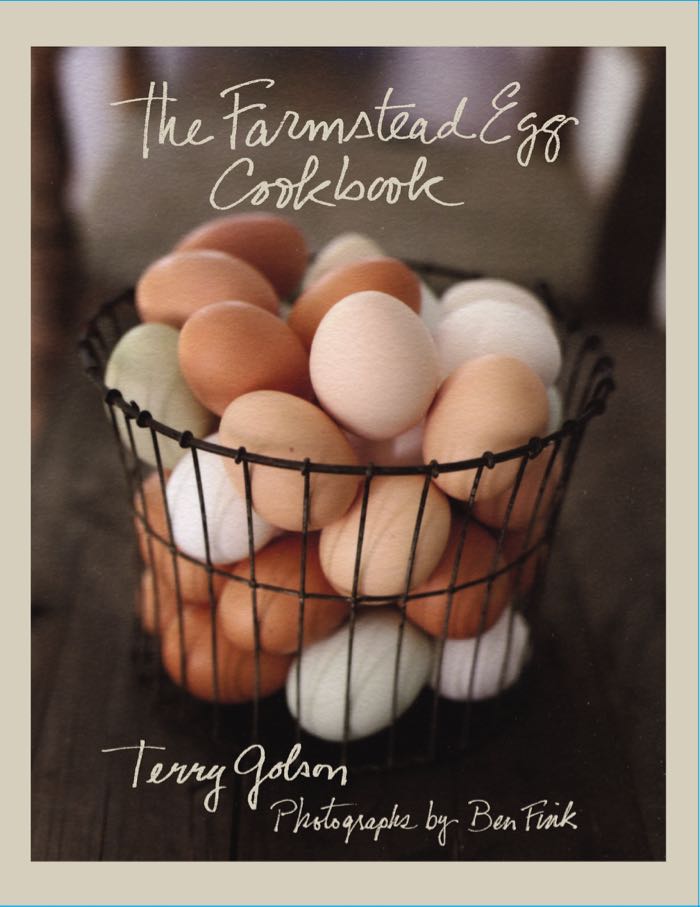
However, the pie tasted wonderful, and we have eaten it all up. Still, what went wrong? The old expression, do as I say, not as I do, applies here. In my Farmstead Egg Cookbook I write about how eggs from backyard flocks come in various sizes and that for baking recipes, one should weigh them first. I didn't. I since have. It turns out that what looks normal to me these days are jumbo eggs. Huge. Duck sized. Who knew that Alma was laying eggs that top the scales at 2 3/4 ounces? And that no one was laying a medium egg, or even a standard large 2 ounce egg? I'll spare you the math, but with three eggs in that pie, I used 40% more eggs than the recipe called for.
Next time, I'll weigh my eggs first. Steve says that I just need to make a bigger pie.
The egg on the left is the only 2 ounce egg in the carton. Buffy laid it. The one on the right is the 2 3/4 egg from Alma.
Chores
September 17, 2007
If you are thinking about getting chickens, you probably want to know how much time it takes to care for them. I'm not the best person to ask- I've been schooled in the fastidious ways of British stable managers (ingrained in me years ago at a riding school) and I keep the chicken coop raked and tidied in a manner that would make Mrs. Sivewright proud.
But, really, even my compulsive efforts in the barn take very little time. In the morning, the hens are tossed some "scratch" (cracked grains that are good for their digestion and keeps them busy), the waterer is emptied, scrubbed and refilled, the pellet feeder is checked to make sure there's still food, and the nesting boxes are cleaned out (the party girls like to roost there, I clean it out with a kitty litter scoop). In the afternoon, I make sure that everyone is okay and I collect eggs. When it gets dark, the hens in the new barn are closed in because their run doesn't have predator/hawk netting. Altogether it takes less than 15 minutes.
About once a week I decide that the coop needs cleaning and I shovel up the mess under the roosts and add fresh shavings. In the spacious new barn, every other day or so, I use a fine-tined pitch fork to pick up droppings. Just like cleaning a stall, but the manure is on a smaller scale!
The coops' dirt runs are raked clean about once a week. Some people like to leave a litter of straw, but I don't like the mess or the smell. In the winter, when the ground and the poops freeze, I do put down a layer of hay, and add more as needed. In the spring, it gets raked up and composted.
Many people justify keeping a flock to "teach the kids responsibility." I suppose that is a good idea. But my children don't take care of the hens. My husband and I like doing the chores too much to let the kids have a turn.
Chicken Breeds and Personalities
September 14, 2007
I have recently spent time with a few of my chickens meeting and greeting the public in Whole Foods parking lots (thankfully under tents, in shade, with ample snacks for both me and the girls.)
The first thing that people comment on is how pretty my hens are. The feathers aren't just brown or white! I explain that, just like there are dog breeds, there are chicken breeds. I go on to explain that the differences between chickens are more than skin (feather!) deep. Just like a Golden Retriever has a different personality than a Jack Russell, that so too, does my Barred Rock hen act differently than the Americauna.
I am not surprised about how little the average person knows about chickens, but I am still taken aback at how rarely they apply what they do know about pets to domestic farm animals.
That a person can live with a dog, and talk on and on about Fido's personality, and yet find it surprising that other animals also have individual temperaments is interesting to me. Have we really so separated farm animals into a class by themselves that they are seen, by the average person, more like a green beans than animals?
Of course, even within breeds, there are differences between individuals. I can tell - from a distance - which of my New Hampshire Reds is Marge. She's the one making a complaining ruckus. Petunia is quiet. Of the Australorps, Twinkydink is bolder; Blackie can't bear being anywhere but in the coop near the others. Of the party girls, Egger likes to be held, Betsy only puts up with it.
This idea, that even the animals who provide us with food, are individuals, is discomforting for many people. It's a lot easier to buy and eat eggs that come from what look like Photoshopped clones. It's easier to eat bacon when all of the pigs are simply piggy animals eating at the same trough.
Oops, sorry for slipping into this diatribe. I'm not a vegetarian. I'm not even an extreme animal rightist. But I do believe in being thoughtful. Personally, knowing my animals brings me great pleasure. Buying meat from farmers who know their animals brings me satisfaction. I hope it does for you, too.
Blog Topics
September 10, 2007
It occurred to me that despite the fact that I am a food writer, that I don't write about cooking on my blog. I do try to keep this blog focused on the hens, but still, they provide me with a supply of eggs, of which I use at least a dozen a week, so it wouldn't be straying off the topic of this blog if I wrote about cooking.
My dear friend, Katherine Newell Smith, came for a visit. She is the incoming president of Les Dames d' Escoffier, a food PR professional, and like me, passionate about what she eats. What did I cook for her breakfast on Saturday? Scrambled eggs. No sauces, no fancy preparations. Just eggs, butter, salt and pepper. There was also Oatmeal Honey Bread (that I had baked the day before) and very good plum jam that I'd found at a farmers market. That's it. We were quite happy with the meal. Perhaps I'm not writing about such things because it seems so obvious. The eggs are so good - just crack and scramble and you have a perfect meal.
Of course, that's not all there is to cooking with eggs. I got to say what I wanted to say about egg cookery in my Farmstead Egg Cookbook. But, if you'd like to hear more in my blog, email me with your food comments and questions. I really do love to cook and talk about it, even if that hasn't been so obvious here!
Traveling With Chickens
September 3, 2007
Have you ever taken a road trip with your chickens? I don't mean boxing them up in cardboard carriers and taking them to shows; I'm talking about traveling with them as you would with your dog in the car.
On Friday, I bedded a large wire dog crate with fragrant timothy hay, secured it in the back of my car, (a small SUV) and put in Marge and Eleanor. They pecked at the hay and settled in. We drove down the highway for an hour. The hens looked around, craned their necks at the sights, and moved about in the hay (which kept them secure - no slipping, even on curves.)
Marge and Eleanor are good traveling companions. They even seemed to like my choice in music.
It was Labor Day weekend and I was careful not to speed, as there were plenty of police out monitoring the roads. But it did cross my mind that it would have been fun to be pulled over and have Marge make a ruckus at the cop.
We had a fine time at our destination - a parking lot at Wholefoods in Bellingham, where the customers got to meet my hens, pet two baby water buffalo and see a live beehive. Sure, it was a promotion, I tried to sell some books, the water buffalo people showed off their yogurt, etc., but, in the end, it was really about having people connect with where their food comes from. Besides, how often on a busy Friday night do you see harried shoppers grinning with delight?
The girls ate organic cheese crackers and looked interested in everyone who stopped by. Marge was unusually silent. I think that she was too busy to do her usual clucking, complaining rant. But, when I loaded them back up in the car, she started cackling. I don't think that she wanted to go home.
It was dark by the time we hit the road, and the girls fluffed up, settled down and slept. I drove with the windows open, the smell of good hay swirling through the car, and content chickens in the back. Not your usual vacation Labor Day road trip, but it was fine, all the same.
The Mystery of Snowball
August 24, 2007
Three years ago at a poultry show and swap meet, we were lucky to find and purchase Snowball. The woman who sold her to us said that the hen was a Bantam White Leghorn. Everyone adores this little bird. She loves people, likes to be held, and has the funniest beepy cluck. Of course, when I wrote a children's book about chickens, she was chosen to be the star. (Snowball Lays an Egg, due out in 2009, published by Scholastic.)
Afraid to have all of my eggs in one basket, I decided that we needed a couple of more Bantam White Leghorns as stunt doubles. Besides, Snowball is so much fun, I wanted more of the same breed. Don Nelson, a poultry judge and breeder from Rhode Island sold me the "party girls" - Eggers and Betsy Ross.
Now, Don knows what a Bantam White Leghorn is supposed to look like, and the party girls are gorgeous. But, put side-by-side with Snowball it's clear that these chickens are not the same breed. Snowball is rounder, her feathers held at less of an angle, her neck thicker. AND she lays light beige eggs. The real Leghorns lay pure white eggs.
So, what breed do you think Snowball is? I'd still like to find some stunt doubles. But I doubt that I will. Snowball is one of a kind.
Roosting Behavior
August 22, 2007
One way to better get to know your chickens is to watch them at dusk, as they settle in to the coop at night. There is the inevitable jockeying for position. Top ranked hens get the highest roost. In the Hencam barn, the most vied for spot is the roost next to the top nesting box. Marge will get there first, but them up comes Eleanor who squeezes in and pushes her over. Blackie doesn't even bother to try to get that prime real estate.
Friends sleep together. Betsy Ross and Eggers perch next to each other on the edge of a nesting box. Marge and Petunia like to be near each other. Petunia, for some unfathomable chicken-brained reason, is my only hen that sleeps facing the wall. The other hens, with that nice hen rump right in their faces, peck at her tail feathers. It's not mean or aggressive. They can't help themselves. That's why Petunia's tail looks so scrawny.
Recently, with chilly night temperatures (50's!), the hens are sleeping closer together. Snowball is up to her old tricks. She wedges herself between the two fluffiest girls on the highest roost and stays toasty warm between those live feather comforters.
Signs of Autumn
August 16, 2007
Here in New England the season is changing. Goldenrod is in bloom (that's a tall, yellow plant that fills abandoned hay fields), the pumpkins are turning orange (the photo below is from my garden), and Candy is shedding clumps of fur and replacing it with her winter coat. She is also eating like a pig and layering on the fat to keep warm this winter.
As far as I can tell, the chickens are oblivious to the coming cold. However, some are molting, which might be linked to the falling temperature, or perhaps the fewer daylight hours. Walking into the coop in the morning, and seeing the feathers strewn across the floor, I startle, thinking there's been a predator attack, but, no, it's just the hens losing their old feathers and growing in new finery.


The Noble Ig Nobel
August 13, 2007
I am sure that many of you are nerds (in this family, that is a compliment, not an aspersion) and so you will be very excited to learn that this year's Ig Nobel Awards will feature the CHICKEN!

For those of you not familiar with the Ig Nobels, these are awards for real science, that should never, ever be repeated. The awards are given out by real Nobel Prize winners. One year, an Ig Nobel went to the inventor of blue Jello, another year an Ig Nobel went to the acoustic scientist who studied why people hate the sound of chalk screeching on chalkboards.
I can't wait to see what chicken research the Ig Nobel committee believes is worth their attention. My husband and I will be there. We are contacting the organizers to see if they would like some live chickens on stage.
Dining Out
August 9, 2007
I'm helping to organize a fancy, expensive annual dinner for about 100 women in the food professions. The chef presented his menu to us, and each of the 7 courses were his most extravagant creations. Meat, mushrooms and cream formed it's base. My first reaction was, this meal is brown and boring!
The pleasures of the new "farm to table" cuisine (you know, the ever so trendy buy local) is that the chefs have a great love and respect of the basic ingredients. They don't want to hide them; they want to showcase them. A beet looks and tastes like a beet, chard is wilted, not pureed with cream into pablum. And the meat! Often from rare breeds, raised in small herds, on pasture, it has a different flavor and fat profile than what you usually see coming from the huge farms. A chef has to handle it just so. A good chef brings out the flavor notes of the region.
I've been away for a few days, researching my next book. Part of the research required that I dine at the Sheppard Mansion in Hanover, Pa. Their chef, Andrew Little, grew up in this area that is rich in agricultural resources. Luckily for Hanover, after stints at some nationally known restaurants, he returned home. In Hanover, he knows the "tomato lady" and the cheese maker and where to find the best sweet corn. The owners of the Mansion raise Scottish Highland Cattle, just to have good beef for the table. They've contracted with a farmer for pastured pigs. I'm trying to convince them to raise their own chickens.
The food, from a chef who spends much of his time sourcing ingredients, is just the way I like it- dishes sparkling with color, and with flavors that speak of the ingredients. It doesn't hurt that the breads and desserts are made with care on the premises. (I live and die by the bread basket.) Best of all, after a three-course meal, I felt sated but not bloated.
The best thing to do after a meal at the Sheppard Mansion is to spend the night there. I had to do that, too, for my research. (Yes, it's a hard job, but someone has to do it!)
The Best of Summer (A chicken's perspective)
August 2, 2007
By now, you're all bored (I know I am) of food writers rhapsodizing over tomatoes warm from the garden and the fleeting glory of local corn. Don't get me wrong - I never tire of those foods themselves, I just don't want to be told, yet again, to appreciate them.
The chickens don't need to read the food pages to know what is right about summer. First of all, there are the Japanese beetles, which my husband catches for them in a plastic tub that has a little water in the bottom. That way, the wet bugs still move around but can't fly off when he tosses them into the chickens' pen. (Yes, he does spoil the girls.)
The hens stay busy pecking off the last little bits of the kernels off of the corn cobs that we people missed. They get weeds (right now, a lot of crabgrass), and the other day I tidied up the mint bed, so they had a spa treatment - minty aromatherapy! (Did you see Candy sitting on the mint looking absolutely zen-like?)
This summer, without my vegetable garden (it's almost finished being constructed), the hens have had to do without the bounty of grubs that I invariably dig up. But, they've made do with some nice grasshoppers.
Then, after a summer shower, there's the sparkling raindrops to peck at. And the weather is so warm, that the chickens can run around in the rain, which, for a chicken, is almost as enjoyable as a dry, hot, dust bath.
The chickens don't need summer camp or organized sports to stay active. Once in awhile a bug will fly by a chicken. The other day, there was pudgy Marge, leaping around the pen. She looked crazy, but then I saw her nail a flying moth. Marge looked quite proud of herself, and rather satisfied.
Isn't summer wonderful?
Prudence
July 24, 2007
This morning I found Prudence dead on the floor of the coop. Yesterday she was a healthy and happy member or the flock. I can't say for sure what happened, but I've got a good guess. Prudence liked to roost on the roof of the nesting boxes. Unlike the metal boxes that you can see in Hencam, the boxes in the new barn are homemade and have a plywood top. The top is sloped, but not so steeply that a hen can't balance up there. I think last night, she slid off in her sleep, conked her head on the concrete floor, and that was it. Those of you without chickens might be incredulous that a falling chicken wouldn't wake up and save herself. Those of you with chickens, who have ventured into your coop at night, know how deeply hens sleep. This is why predators can kill off an entire flock in the dark. My husband is going to take the roof off of the nesting boxes. We'll never again have a nesting box that a hen can precariously perch on.
Prudence is already buried under the new vegetable garden. When you live with chickens in your backyard you know that there will be deaths. Predators and disease take most. If you're lucky, some will die of old age. Sometimes you don't know what did your hen in. Whatever the cause, it's always sad.
It's a cliche, but life goes on. Two days ago, Alma laid her first egg. It was small and dark brown. Several of the hens have started molting, which means that they will look scraggly for weeks until their new feathers grow in. Marge, who spends most of her days in the bottom nesting box, looks especially messy. Don't worry about her - she's fine. Molting hens don't lay, so egg production is down. However, the girls are earning their keep - we feed them Japanese beetles, which they devour with gusto. Their enthusiasm fuels my 9 year old son, encouraging him to collect the bugs off of my flowers. Next week my new vegetable garden will be ready for planting. I think I'll grow some kale, just for my good hens.
New Vegetable Garden
July 17, 2007
There's a lot of commotion going on behind the new barn that you are probably curious about.
My vegetable garden was where the new barn is, so when the barn went up, the garden was dismantled. I've missed pea season, but my garden is finally being reconstructed behind the barn in a sunny spot in the meadow. The area will be about 20 by 27 feet, and fenced to keep out deer and woodchucks. There will be raised beds and a faucet to hook my waterer up to. Sorry that you can't see it, but I'll post photos when it is completed.
Folk Medicine Cure?
July 16, 2007
Betsy Ross should have been a goner. She had a prolapsed vent that stuck out of her butt a pink inch. You can't leave a bird like that in with the flock, or they'll peck her to death. Even in isolation, it is likely to swell and get infected. And, if you do manage to push it back in, the hen will proplapse again the next time she lays an egg. The books and the university extension Web sites tell you to cut your losses and cull.
Despite the doom and gloom I wanted to try and save Betsy. I washed her vent clean, trimmed the surrounding feathers (carefully, with scissors), and smeared the prolapse with Preparation H and pushed it back in. I put Betsy in a small dog crate with food and water and lined with clean newspaper. The vent soon prolapsed again. I repeated the Preparation H treatment. She showed no signs of distress or discomfort, but that prolapse wasn't going away.
Then I read on the Backyard Chickens forum, that someone had success with an old folk remedy - honey. I didn't have much to lose, so I got some from the kitchen and spread about a teaspoon's worth on the prolapse, then I pushed the flesh back in where it belonged. It stayed!
Now, I don't know if the the honey was the cure. But, honey is hygroscopic (it absorbs moisture from the air) and perhaps it helped to dry out, but at the same time, protect the prolapse. Or, perhaps the stickiness of the honey helped keep the proplapse in place. Or, maybe it was a combination of everything; the Preparation H reduced the swelling, the rest and clean environment allowed for healing, and the honey did the rest.
Yesterday, Betsy Ross rejoined her flock. Egger had missed her and is very happy to have her friend back. I'll keep a watchful eye on Betsy. Once a hen prolapses, it's likely to happen again. But for now, it looks like that sure goner is here to stay.
Lucky
July 11, 2007
Some of you got to see how fast I can run. Yesterday I had Perrie in the isolation stall in the new barn. She was looking poorly, hunched over, not moving, and not eating. The stall has netting across the top to keep chickens in. I guess that Perrie felt better, because she squeezed out of the netting and flew out of the barn - unfortunately straight at my dog Lily. Fortunately, I was busy in the yard and saw Lily leap up and grab Perrie, then pin her to the ground. That's when some of you got to see me run past the asparagus bed to save the chicken. I grabbed Lily's collar and yanked her off of her feet. Perrie came up with her, clamped in my dog's mouth. I pried Lily's teeth open and Perrie hit the ground running towards her flock. Feathers swirled around us. I shooed Perrie into the pen and dragged Lily into the house.
I went back out and found Perrie hiding in a corner of the coop. I was surprised to see her standing. I picked her up and felt all over. I fully expected to find puncture wounds. Not a scratch.
I don't know why Perrie looked so sick yesterday morning. Perhaps it was indigestion? Did she eat a bug that didn't agree with her? Perrie has a particularly fine, thick coat of feathers. When she looked ill, she fluffed up and appeared ready to molt, but luckily for her, she didn't. Those feathers saved her. Lucky girl.
PS Betsy Ross remains in isolation and she still has that prolapse. I tried an old folk remedy today - smearing honey on it. What we'll do for our chickens.
Prolapse
July 9, 2007
Yesterday morning I noticed that Betsy Ross' vent area (for you chicken neophytes, that's her butt) was messy with runny poops. I bathed her bottom (gentle dog shampoo in warm water) and could then see that she was suffering from a prolapsed cloacae. This happens when a hen lays an egg that is too big, and she pushes out some of the vent along with the egg.
All of the extension service poultry Web sites will inform you that a prolapse is cause for culling. The other hens will peck at the red butt (the sites don't use these exact words), and /or infection will set in. Besides, once a hen prolapses, even if fixed, it'll happen again.
I'll try to save Betsy. I purchased some Preparation H, and applied it several times yesterday. I pushed the prolapse back in. But it doesn't stay in. She's been moved into a little dog crate, safe from the other hens. She's eating and drinking and bright-eyed. No infection yet. I'm not optimistic, but I won't give up on her.
As with any animal that you own, you are responsible for their well-being. You do the best you can. But there are limits, especially with farm animals. A farmer could more easily put a price on what it is worth to save her, both in time and money. In my little farmette, Betsy straddles that line between pet and producer. I'll nurse her. I'll bathe her. I'll take the time to care for one little hen. But, she won't be going to the vet (which would be a costly long-shot) and I'm prepared to cull her if she suffers. This is the reality of living with chickens.
Pecking Order
July 5, 2007
Pecking order in chickens is literally determined by pecking. Usually, this jostling for status is only briefly dramatic. Once everyone knows where they stand, the top hen just has to turn her head in a threatening manner, and the lower-ranked hen moves off.
When I selected the seven hens to live in the new barn, I based my choices on which ones I wanted in my children's book. I picked six hens out of the flock that I already had, and I decided to purchase Prudence, as I wanted a classic solid brown hen, too. I've never had a problem integrating a new hen into a flock, so I was chagrined that Prudence was not only at the bottom of the pecking order, but that the other hens kept her there aggressively. Poor Prudence's comb was ripped raw and she spent her days on a window ledge avoiding the other girls.
It became clear that Petunia had it out for Prudence. I don't know why. Today, I finally decided that enough was enough. When I saw Petunia grab Prudence by the tail feathers, and then Edwina pin Prudence down and peck viciously, I ran into the run, picked up Petunia and put her in the other pen (the one you can see on HenCam.)
As soon as Marge and Petunia saw each other, they fluffed feathers, chest-butted and then Marge clucked loudly, welcoming her old friend back into the flock. And even though there are hens in this group that Petunia doesn't know (the Party Girls and Alma), she doesn't appear to have any of the antagonism towards them that she showed to Prudence.
Prudence has left her window shelf. Edwina half-heartedly chased her, but without head-girl Petunia to be the aggressor, Edwina doesn't have it in her to do it alone.
Friendship is a mysterious thing, even in the animal kingdom.
Scooter
July 3, 2007
I am not a toy dog person. I don't like shivery, yappy little dogs, and I certainly don't like to see tiny dogs used as fashion accessories. I look for athleticism and brains in my dog companions. So, I am a tad embarrassed to tell you that I happen to have the cutest little dog in the world.
Scooter looks to be a mix of Corgi, Chihuahua and some sort of rough-coated terrier. When I picked him out of the litter, I knew he'd be small, but not this small! At six months, he is just over nine pounds. He'll max out around 12. I knew he'd have Corgi turned-out feet, but who knew he'd have comical bow legs? I noticed that his mom had an underbite, and at 5-weeks when I peered into Scooter's mouth, it didn't look perfect then, but I had no inkling that he'd have such a toy dog face with a jutting lower jaw.
Luckily, Scooter's bark is as deep as a St. Bernard's (he scares delivery men!), he's got a terrier's attitude, nothing fazes him, including my big, athletic, smart dog, Lily (who thinks that Scooter is the best toy I've ever brought her) and, best of all, Scooter cuddles with my kids (something that Lily doesn't do). Everyone is ecstatic about this addition to our household. Surprisingly, even me.

One More Thing About Broody Hens
June 25, 2007
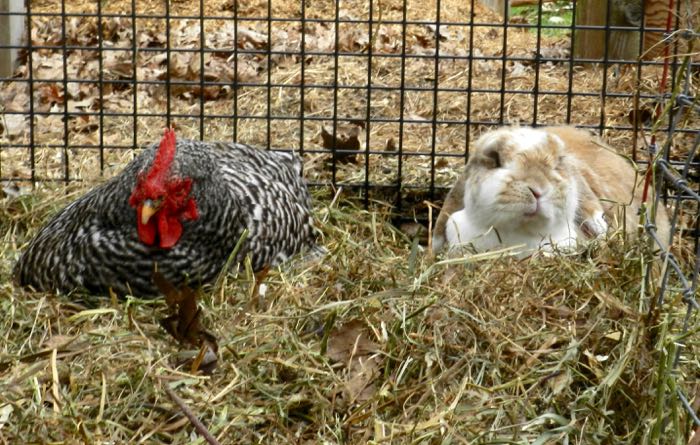
One myth about broody hens is that the hens go all sweet and motherly. Children's books depict the hens wearing calico scarves on their heads and smiling. I wish someone had told Blackie that's how she's supposed to behave. A few times a day I pick Blackie up and put her outside. It's to be expected that she doesn't want to leave her nest. Still, she turns into a raging henzilla. Because her feathers are all fluffed out (broody hens do this to increase body temperature), she looks twice her size. Whichever poor girl is in her direct line of sight gets charged at. This is one bad-tempered hen. But Blackie got her comeuppance today. She went after Candy and got a beak full of rabbit hair. Blackie spent the next five minutes trying to get it off. This was such a distraction that her feathers laid down flat and she looked like the placid hen that she normally is. Unfortunately, she's back on the nest, and her raging alter ego is back.
Broody Hens
June 18, 2007
It's that time of year when half of my emails are about broody hens. A broody hen is one that stops laying. Instead, she is fixated on sitting on the nest as if she is going to hatch a clutch of eggs. A broody hen will sit whether there are eggs under her or not. Her feathers will fluff up and she might pluck a few out, all so that her body temperature rises, so if there were eggs there, they'd be the right temperature to develop into chicks. Broodiness varies by the hen and the breed, but it can last several weeks.
Most broody hens do get up to eat and drink and poop, although you're unlikely to see that as it will be a brief excursion. With Hencam, I can spy on my broody hens, and I know they are doing fine. Still, whenever I go into the coop, I unceremoniously scoop up the broody hen(s) and shove her outside into the pen. She always eats and drinks before coming back to the nest. Snowball, my broodiest of hens (is anyone surprised at this?), rasps a warning at me when I pick her up, but I ignore it and toss her out. Within seconds, she is happily scratching in the yard. But only a few minutes later, the impulse to brood takes over and back in she goes.
Hens bred to supply most of the world's eggs have been selected to lay an egg each day, and once they've done their job, to ignore that egg and eat and drink so that they can make more eggs. Even some of the old-time breeds of chickens were developed to lay but not sit on their eggs. This makes a lot of economic sense. So, even within a backyard flock, only a few hens might be broody at a time. I tend to tolerate the reduced productivity, but I do get the the hens off the nests a few times a day to make sure that they are drinking enough.
If you only have three hens and two are broody, you will yearn for fresh eggs and want to break the broody cycle. During the day you can lock your hens out of the henhouse and away from the nest. Or, you can put your hen in a wire cage (with food and water) - the air circulating under the hen will cool her body temperature, which will send a message to her body that the broody cycle is over. Or, to speed that up even more, put a bag of frozen peas under her. (Then feed them to the hens when thawed. It's a welcome treat.)
Broodiness is a normal thing for many hens. First time chicken keepers often think that their hens are sick. Don't worry, they're not - but they are boring sitting there all day! Despite your hen's protestations, it is good to get them up and out. But, breaking that cycle takes effort, and you have to be more determined than your chicken! I'm sorry to say that in this flock, Snowball always wins.
(Viewers of Hencam will notice that Blackie is currently broody.)
Flock Health
June 11, 2007
At the beginning of June the hens in the new barn got terribly sick, and when a disease hits a flock, it hits hard and fast. Within days every hen - except Prudence - had swollen eyes. Some had eyelids so puffy that they couldn't see to eat.
A vet diagnosed Mycoplasma gallisepticum, (MG). The bacteria which causes MG is an odd creature; it lacks a cell wall. That means that it is fragile when it is outside of the birds and can be killed with heat, sunlight, disinfectants, or simply time - after 3 days, it dies. But, inside the birds, it is virulent and can lead to severe respiratory disease. Fortunately, I caught it in time before that happened. Also, fortunately, there are drugs that work.
Thanks goodness for drugs. I'm one of those people who buy "antibiotic-free" meat, but I am so grateful that drugs are available to save my pets (and children!) So, don't even get me started on farmers and doctors who use these sub-therapeutically, creating drug-resistant, highly dangerous, bacteria. (And really don't get me started on people who chose to travel for their own pleasure, knowing that they could transmit drug-resistant TB!)
Anyway, a vet visit and $200 dollars later, my hens are on Tylan, an antibiotic powder mixed in their water. I also put terramycin ointment in their eyes for a few days. Now, all of the hens look 100% fine. BUT, although MG is easy to kill outside of the body, inside it remains viable for several weeks, even after all symptoms have passed. So, they will remain on the Tylan for 3 weeks, in the hopes of killing it all off. I'll have to live with the knowledge that my hens might be carriers for the rest of their lives. I won't take them to shows and I won't breed them.
There are a few theories about how the MG arrived here at Little Pond Farm. Perhaps Prudence was a carrier; she's a new hen, and the only one that wasn't affected. Then again, she stays away from the other hens (who don't like her at all) and so perhaps, she just didn't get in contact with the MG (which spreads by touch, not through the air.) My husband thinks that perhaps he was the vector. About a week before the outbreak, he scrubbed out moldy bird feeders and refilled them. He tromped through the barn several times during this task. Wild house finches suffer from MG and it is a likely scenario that he brought it into the barn.
In any event, it is over (for now, at least) and it is a pleasure to go out to the barn and have cheerful, bright-eyed hens greet me.
Thank You
June 7, 2007
I started this blog about a year ago, and I've so enjoyed hearing from Hencam viewers. You've shared your enthusiasm for poultry, your humor (it's a rare person who lives with chickens that doesn't have a humorous take on life) and your questions. I've been told great stories about memorable hens. I've heard from people from Australia, Africa, Great Britain, Spain, Argentina, Canada, and the US (sorry if I left anyone out!)
But I have to tell you, that the concern and support - and good humor - that I've received since telling you about the illness to strike my hens, has not only lifted my spirits, but I've learned a lot, and it has helped my girls. I've had people send me well wishes, and links to Web sites with the information I needed, and Buffy even got a get well card! (Hilarious - it's a hen saying, "And no matter what, don't let them tell you that soup will help.")
The only hen that remains puffy-eyed is Snowball, and I think she'll be fine by tomorrow. Her understudies, the beautiful Betsy Ross and Egger, were eagerly waiting in the wings (pun intended) to take Snowball's place in this weekend's photo shoot. But the young girls will have to wait their turns. Snowball remains the star.
After all of the stress of this week I'm off to an early bedtime. I'll fill you in next week on what I've learned about mycoplasm gallisepticum and avian conjunctivitis.
Thanks!
Getting Better
June 6, 2007
The drugs are working and everyone is on the mend. Buffy suffered the most and remains puffy-eyed and uncomfortable. Snowball, after a day with her eyes squeezed shut and holed up in the nesting box with her tail to the world, is looking around and is out and about. The other hens appear almost normal, and unless you are acutely observant, you wouldn't know that they've been sick. Prudence never succumbed. Perhaps she was the carrier?
I've had sick hens before, and have had hens with respiratory ailments that died, but I've never had an illness sweep through the barn like this. I don't wonder why farmers cull a bird at the first sign of disease. Also, like human medicine, the drugs are expensive - I've spent over $60 so far. Then, there's the issue of transmission. These hens are saved, but will they pass this disease along to the next bird to join the flock? If I was a farmer, I wouldn't want to wait to find out.
But I'm not a farmer; I have these chickens for eggs, but they are also my pets. They're treated and they get to stay.
That said, I have some questions that my vet couldn't answer. Some readers have sent me links to academic papers, which don't have the answers either. I need to know:
*How long can mycoplasm gallisepticum survive outside of the bird? At what point can I put the dirty shavings from this barn into the compost pile?
*Is it true that a hen that has recovered from the symptoms will be a carrier for life? Has anyone done studies on this or is it simply a cautionary assumption?
*Once the symptoms are over and the eyes are clear, how likely is it that I will carry the disease into my other barn? A backyard situation like mine is not set-up for biosecurity. Children visit my hens. I am in and out several times a day. I can't change clothes when going from one barn to another! Already, one chicken was swapped from one barn to another (just days before the outbreak) to no ill effect. What is realistic to do and to expect?
It's unlikely that there will be any studies funded on issues of health in backyard poultry flocks. So, It'd be helpful if anyone who has experienced this write to me. I want to know about your flock after the illness passed through! Thanks.
Sick Hens Update
June 5, 2007
I found an avian vet! Although not very experienced with pet hens, at least she was willing to see Buffy.
Poor Buffy, both eyes are crusted with yellow mucus. She looks miserable. The vet gave her a thorough exam and, thank goodness, except for a swollen comb and sinuses, Buffy doesn't have any symptoms of respiratory disease.
Dr. Rittle believes that Buffy has avian conjunctivitis, a disease caused by mycoplasm (a unique form of bacteria). It is found in poultry flocks, but also in wild house finches. Because I have two other hens, Ginger and Petunia, who had swollen eyes that healed with antibacterial eye ointment, this diagnosis sounds logical. I could have had blood work done to confirm this, but it would have added $50 to my vet bill that had already cost $114, and so I opted out. If, however, Buffy doesn't respond to the medication, or another hen becomes ill with worse symptoms, I'll be right back to see Dr. Rittle.
Conjunctivitis is spread by direct contact, so it is easier to control than an airborne illness. I have a dispenser of hand sanitizer in the barn, which I will use frequently. Buffy is isolated in a dog crate. I will be bagging and throwing out dirty shavings, not composting them. Hopefully, Buffy will be the last hen with this disease.
I don't know where it came from. Perhaps Prudence was a carrier - a perfectly healthy looking bird can spread it. Perhaps some infected house finches had contact with my flock. You can really understand why farmers need to practice biosecurity, and the risks (though I think worth it) that free-range farmers take.
Sick Hens
June 4, 2007
Some of my hens are sick. A commercial farmer would cull (a euphemism for kill and dispose of) these chickens. It makes sense - diseases spread quickly and devastatingly through a flock. There is usually little time between onset of the ailment and death. If the problem can be treated with drugs, then the eggs (or meat) can't be consumed. A farmer doesn't have much choice.
But my hens aren't my source of economic livelihood. They are named animals with known personalities. They're part of our family life. I'll do what I can to keep them alive.
I'm not sure what exactly is going on. When Prudence was introduced to the flock, she was (and remains) a very healthy looking bird. But she and Petunia got into a pecking order scrap and Petunia came away with a swollen eye. I treated the wound with antibiotics leftover from an eye injury that I had. Soon, Petunia looked fine. She never went off her feed or looked ill in any other way.
Then Ginger's eye swelled up. Was this a case of an aggressive hen going after eyes? I isolated Ginger in a dog crate and used the antibiotic. She ate and drank and, other than the eye, which is looking much better, seemed fine. Back she went in with the flock.
But, today, I noticed that Buffy was hiding under the ramp outdoors, in the pouring rain. Both of her eyes had what looked like spittle in them. She looked tired. I have isolated her, and will start antibiotics in her water if she doesn't look better by this evening.
So, what is going on? Did Prudence really injure Petunia, or was Petunia's swollen eye a sign of disease? What about Ginger? And why does Buffy have two puffy eyes when the other girls had only one each? If it is a respiratory bacterial infection, when why are their noses and throats fine?
Anyone out there have this problem? Please email me.
PS The photo shot was postponed until next weekend. Let's hope everyone is healthy and photogenic by then!
Chicken Training
May 29, 2007
The first photo shoot for my childrens' book, Snowball Lays an Egg, is happening this coming weekend. I have been preparing the 7 hens in my new barn for their moment of stardom by training them to pose next to a target stick. I've also been trying to get them to go in and stay in a nesting box on cue.
It turns out that some hens have more aptitude than others for this sort of thing. After only a few days of training sessions, I decided to replace my New Hampshire Red, Marge, with her sister, Petunia. Marge was posing just fine - but she was too obnoxious! Marge is the loudest hen, and she clucks with such an insistently complaining tone, that I just couldn't work with her. Petunia, on the other hand, is a pleasure to be around.
I've always loved the Australorps, Twinkydink and Blackie, because of their calm natures. Physically, I can't tell them apart. One of them went into the new barn. After a week of training sessions, it was clear that she couldn't handle any separation from the flock. Even if she could see the other hens from the other side of a screen door, she'd fly into a panic. So, I switched her with her twin, who I am calling Twinkydink. This Australorp (same age and background) is also nervous, but can be handled and trained.
So, for those of you keeping track, in view on the Hencam are Blackie and Marge.
Meanwhile, luckily, thankfully, Snowball has emerged as a true star. She follows the target stick and stands next to it. I have gotten her to walk in a circle on the roof of toy truck - a skill she needs for this book!
Training animals is a window into their personalities and quirks. Not only have I learned breed differences (the Barred Rocks will do anything for food, and the Orpingtons are gentle but nervous), but I've learned about each individual in my backyard flock.
Now, if I could find the time, maybe I could train my puppy, Scooter!
Name That Hen!
May 23, 2007
Thank-you to everyone who wrote and suggested a name for my new Rhode Island Red. I had such fun reading your emails. Selecting a name was very difficult as there were so many good choices.
Several of you suggested the names of favorite redheads. I particularly liked "Lucy" for Lucille Ball, Brenda Starr and Red Henlton (for Red Skelton).
Then, there were the plant and flower names, such as Pansy, Fern and Rosemary. I think I shall name my next hen Philanthra, which means "lover of flowers" (is there a word which means lover of eating flowers?) I also liked the food names, especially Salsa, Brownie, and Miela (which means honey in Italian.)
Also in the running were the cheerful names, like Emily (who came with a delightful nickname - Emsy LuLu), Mitzi, Dixie, and Clarissa.
Many entries found inspiration in the state that this breed was developed. Rhoda and Rhodie were popular. One person suggested Buddy - for Buddy Cianci, the infamous, corrupt, RI politician now out of jail.
Rhode Island is a small state with delightful placenames, such as Tiverton, Bristol and Little Compton, all of which would make excellent names for a Rhode Island Red. The winner suggested the name of the third largest island off the coast of RI, Prudence. I love old-fashioned names for hens, and since this also had a Rhode Island connection, I couldn't resist.
The winner hails from England and will be starting her own backyard flock soon. Congratulations Tory!
What Not To Wear
May 22, 2007
This fine, warm weather means that I can dust off my sandals and forget about socks. Joy! So, the other day, in celebration, I painted my toenails red. Today, I wore my Teva sandals when I went into the coop to collect eggs. Big mistake. Chickens will peck at anything red. And red things that move right at ground level are especially appealing. Ow! I'll wear my gardening clogs into the barn from now on.
Coyote
May 19, 2007
A coyote, the size of a German Shepherd Dog, has been using my backyard as a highway to get from here to there. Most coyotes are scrawny animals and they move with stealth and caution at dawn and dusk. Not this one. I've seen it at night and I've seen it at noon. When I do, I go running into the yard, screaming like a banshee. It takes a insouciant look at me and barely speeds up into a trot before it disappears into the woods. I don't let my good farm dog, Lily, out to scare off the coyote - and it drives her mad from inside the house - but I don't want them to tangle.
There are worries you have when you've got domestic animals on your property. Wildlife viewing just isn't the same.
Egg Colors
May 17, 2007

Three years ago I took my family to a poultry swap and show. I told my sons that they could each pick out a chicken. My oldest son selected two silkies (one is never enough!) Jacob, then six years old, spotted a bright-eyed white hen and said, "This one." I was worried. She had a different look than the other chickens. Something lively, something mischievous. Nothing like the sweet and placid Silkies that we already had in the car. Still, my son insisted, so we took her home and named her Snowball. For three years, now, we've collected her little eggs. White Leghorns lay white eggs and we've always described hers as such. But now we have two new White Leghorns, Egger and Betsy Ross. They lay little eggs, too. Theirs, though are truly white. Here is a photo for comparison. The egg on the left is Betsy's. The one in the middle is Snowball's, and the one on the right is from one of our large brown hens. So, yet again, Snowball proves that she is a little different. She doesn't even lay eggs the right color for her breed.
The Name The Chicken Contest continues! I think that I'll have to get more hens just to use the wonderful names that you are sending in! The contest closes on Wednesday, May 23. I'll announce the winning name on this blog.
Name the Chicken Contest!
May 14, 2007
This Rhode Island Red is the newest addition to the flock. She's about a year old, lays an egg everyday, and would like to be top of the pecking order, but has given into Edwina's prowess at chest banging and pecking.
She needs a name! Send me your suggestion, and if I use it, you'll get a signed copy of The Farmstead Egg Cookbook.
Flock Separation
Last night the new barn was finally ready for a full flock. In went Ginger, Twinkydink, Marge, Buffy, The New Hen, Edwina and Snowball. These are the girls who will be photographed for a children's book. Egger, Betsy Ross, Eleanor, Petunia and Perrie are in the coop with the HenCam. And, of course, Candy is still there, causing trouble. It will be a tad quieter on HenCam, but the girls like the extra space. This fall, we'll add another HenCam to the new barn, but until then, I'll just have to tell you about what's going on in there.
There's been a bit of a ruckus getting the new pecking order decided. It's never pretty, what with pecked combs and pulled out feathers and squawking, but it happens quickly. By evening, Twinkydink and Buffy were fluffed up together on the roost as if they've been best friends their entire lives.
Kindergarten
May 4, 2007
Sometimes I think that having a flock of hens is like having a bunch of kindergartners in my backyard. Hens are gregarious, endlessly curious, and vocal. They have friends but don't want to share. They fuss about status and who has what. They like to play in the dirt. And there are always social situations to be resolved.
Snowball has a bad habit of plucking feathers off of other hens. She is sneaky about it - she'll maneuver next to a hen that is sunbathing and peck as if she is mutually grooming, so at first the other chicken doesn't mind - and then pluck! Last year, many of the girls had bare butts because of Snowball. It stopped over the winter, but she has started up again. A time-out and explanation might work for a real kindergartner, but not this girl.
At the same time that Snowball had resumed de-flocking the flock, I bought two new bantam white leghorns. These hens are so pretty in their perfect white feathers and bright red upright combs, that I call them "the party girls." But, instead of having a good time, they've been harassed by the other hens who are bigger and older and don't want to share. Anything. So the party girls went into the new coop. In, too, went Snowball. The party girls are skittish and won't let Snowball near them, so they are still in fine feather.
At first, Snowball wanted to get back to the other flock. But now she's settled in. Sure, there aren't feathers to pluck, but there's a lot less competition for food or the perfect roosting spot. Like kindergartners, hens are demanding but easy to please.
Candy's Summer House
April 30, 2007
Several observant Hencam viewers have asked me where Candy's hutch has gone. It's been moved to the side of the coop, out of view. Rabbits are heat intolerant, in fact, getting too hot is fatal for them. In the wild, rabbits have upright ears that act as natural air conditioners. Hot blood circulates close to the skin, and cools off in the breeze. But domestic lop-eared rabbits can't pick their ears up off their furry bodies. Their air conditioners don't work. And they don't have a cool dirt tunnel to spend the hot afternoons in. (Although, Candy does her best to dig one, the dirt is too packed in the chicken yard.)
In the winter, Candy's hutch is positioned so that she can take a sunbath at 9 am (have you noticed that she does that?) In the summer, the hutch is moved to the coolest place in the yard. I'm sorry that you can't see it, but her health is more important than fame.
Childrens' Chicken Books
April 27, 2007
I'm always on the lookout for childrens' books that feature chickens. There are a lot out there - but I'm fussy. I expect them to get the basic facts right. Recently, I was told about a book, so I checked it out at the bookstore. The illustrations were nice and the chickens looked like chickens. But the text! It said that one character was a "rooster, not a chicken." Did the author, the illustrator, the editor, the designer, and the many other people who work on a book to get it published not know that a "chicken" is a term that covers both males and females?
I did recently come across a charming and exuberant book, Chicky Chicky Chook Chook, by Cathy MacLennan. It has the sort of writing that is fun to read out loud to very little people. "Chicky, chicky chook chook. Chick, chick chick. Chicky, chicky, chook chook, peck..peck...pick." The pictures are silly and colorful. There's even a story line. Sort of. I love it.
For more book ideas, check out my annotated bibliography.
Email me if you have a book I should add to the list!
Pumpkin Patch Help
April 23, 2007
In the back of the backyard, I've got an expanse of thin, sandy soil. I've put up a temporary chicken wire fence around a 15 foot diameter area and dumped in all of last year's compost. I've set up an old patio umbrella, put out a waterer, and when the weather is good - like today - I take three hens out there. They turn over the old leaves and grass clipping and garden scraps, eat up bugs and level it out. They'll have about 7 weeks of glorious scratching, and then I'll kick them out and plant pumpkins. When the growing season is over, I'll have a lovely plot of dirt. Last year's pumpkin patch is ready for wildflowers. I bought 3 packets of seeds today.
Goings On At Little Pond Farm
April 21, 2007
As you've probably noticed, there's a lot going on around here. The inside of the barn was stained this week. Now it has a light gray wash so it doesn't look so yellow and raw. The fence for the new chicken run is going in. Not an easy job, as we'll be burying part of it 6 inches to keep out predators, and since this is New England, you don't dig through loose soil- you make a trench in a mix of packed dirt and granite gravel. Also, I've got some non-standard porch doors from a salvage yard going in. And a new vegetable garden being installed on a slope, so we'll have to put in a stone retaining wall. That's the royal we. I don't do any of this. For close to 15 years, I've relied on Mark from Rudy's Tree and Landscaping.
The outside of the barn will be stained tomorrow. Amazing what some friends will do when you offer BBQ!
And then it's time to divide the flock. Seven hens - the ones that will be photographed for the children's book, will go in the new barn. Snowball, of course, will be one of that flock. Who else? Tell me which is your favorite hen.
Lastly, I'm sure you've spied the two new, pretty as can be, Bantam White Leghorns. I bought them from breeder (and poultry judge), Don Nelson. I know some of you out there say, "I don't have room for a flock." Well, go to a local breeder and buy two hens for your backyard! You can buy gorgeous pullets of just the breed your heart desires. Check the American Poultry Association for a list of shows near you. Go, look at the birds, and connect with a breeder.
Hencam Technical Difficulties
April 16, 2007
When you have a Web Cam running from your chicken coop, figuring out technical glitches isn't as easy as looking in a manual. We've been experiencing intermittent stoppages of the signal. This morning, my IT guy (and wonderful husband) Steve, went out to the coop in the middle of a blowing, raining, Nor 'Easter to announce that he's solved the problem. Well, at least figured it out. The problem is Candy. She found the only exposed wire in the entire backyard area and did what bunnies love to do - she chewed through it. The fix will require a bit of rewiring and a new, metal conduit. It's not going to happen today. Take a look at the weather out there!
Compared to that bunny, the new puppy, Scooter, is no trouble at all. He's got the best, sweetest, temperament.

Snowball Lays an Egg
April 14, 2007
Snowball laid an egg today! She is my only bantam hen, and the only one who lays white eggs. Here is a photo:

The large, roundish one on the left was laid by the Buff Orpingtons, Buffy. The one in the middle is, of course, Snowball's, (it's whiter than it looks in this photo) and the blue one on the right was laid by Perrie, the Araucana mix.
I will not be cooking with Snowball's egg. It will be saved for a photo shoot for a children's book, called, appropriately, Snowball Lays an Egg. It is a silly work of fiction in which Snowball has decided not to lay her eggs in the coop. I won't give the story totally away, but I will tell you that she will be posed in tableaus filled with vintage chicken items and that in each photo, her egg will be hidden somewhere on the page.
How will I get her to pose for the camera? In the next few weeks, I'll be training Snowball to stand on a post-it note. Yes, this is easy to do with chickens! They are so food motivated. I'll be using clicker training. (This is the same technique used to train dolphins to jump through hoops.) You'll be hearing more about this in the future.
Weird Egg
April 13, 2007
It takes about 25 hours for a hen to produce an egg. The process starts in the ovary, when an ovum gets layered with yolk. Then it is released into the oviduct. As it travels down, it gets coated with egg white, wrapped in a membrane, and sealed in a shell. Usually, a hen produces a uniform product, although it can be unique to the hen. Ginger, for example, lays eggs that are pointy on both ends!
Sometimes, though, something goes awry. Yesterday, someone, I think one of the Australorps, laid a teeny-tiny egg. Here's a picture of the eggs collected on Thursday. Note the small dark one in the center:

Sometimes, small eggs don't have yolks. But this one did.

My little puppy, Scooter, who at 12 weeks old is only 5 pounds, ate that egg for breakfast.
(Notice the blood spot. Sometimes a speck of blood attaches to the egg as it makes it's way down the oviduct. Unsightly, but edible.)
It's Spring!
April 9, 2007
My daffodils aren't blooming yet, and patches of snow remain in the shady areas of my yard, but I am absolutely, positively, sure that Spring is here. The sun has warmed the earth in the chicken yard enough so that today the girls scratched out hollows in the packed-down pen, and took the first dust baths of the season. Here is Buffy luxuriating in loose, defrosted dirt.

Dreggs
April 2, 2007
My friends, the talented LaReau sisters, came to visit last month. I sent them each home with a dozen eggs. Kara had tasted them before, but this was Jenna's first time eating eggs from my hens. This is what she says about them: "I'm going to have to come up with a new name for those other things I'd been frying up with my bacon in the morning, now that I know what real eggs taste like. Bleggs? Dreggs? You spoiled me!"
Thanks, Jenna. I've been trying to come up with another word for those factory-farmed supermarket eggs, and I think that dreggs is perfect!
Manure
March 27, 2007
Yesterday was one of those perfect, 60 degree, Spring days. Did I go window shopping, or sit at an outdoor cafe drinking an iced latte? No! I moved manure. I've got an area at the back of my yard that has poor, sandy, pebbly soil. I've had soil trucked in, which is expensive, and it just seems to disappear. Last year, I came up with a better solution. I put a temporary chicken wire fence around a 20 foot diameter area, inside of which I wheelbarrow loads of the coop compost from the previous year. Everyday, or so, I'll take a couple of chickens up to this patch and let them scratch around, spread it, and dig up bugs. In June, I'll plant pumpkins. In the fall, the chickens get to do their thing again.
Last year's patch is now ready for wildflower seeds. Yesterday, Snowball and Petunia got the honor of doing the inaugural scratching in the new pumpkin bed. So, don't worry. If, when watching Hencam, you think that a couple of hens are missing, they're just up in what we call, "hen heaven."
I might be there, too. I've got two lawn chairs right outside the fence. I could bring my laptop and get some writing work done. Or, I could just sit in the sun and watch the girls. Maybe I'll make a latte.
Eating Raw Eggs
March 26, 2007
Are you afraid of eating raw eggs? I'm not. Salmonella, and other serious food-bourne illnesses rarely occur, and when they do, it's usually due to a food processing or food service mishandling problem. The eggs from my hens are clean, my girls are healthy, the eggs are fresh and I keep my kitchen scrupulously clean.
I had some friends over on Saturday and so I made chocolate mousse, adapted from a recipe from Green & Black's Chocolate Recipes cookbook. This is mousse at its most basic. Take 5 ounces of the best dark chocolate you can find (Green & Black's - an organic brand from England is perfect) and melt it in a double boiler with a stick of butter. Meanwhile, separate 3 eggs. When the chocolate is melted, take it off the heat and stir in the yolks. Whip the egg whites with a few tablespoons of sugar (I like the minimum of 3 tablespoons. Add more if you like things sweet.) Fold the chocolate mixture into the RAW egg whites. Plop into a pretty serving bowl. Chill for a few hours.
Sorry that I don't have a photo. It was eaten up before I could get one.
Bunny Snow Fun
March 19, 2007
As you probably noticed, we got a lot of snow. Then freezing rain. So, right now there's about 10 inches of snow topped with a hard, shiny crust. It's not safe for humans to walk on, but it's perfect for a rabbit. Candy, like all bunnies, loves to dig and tunnel (which is why she is no longer welcome in my asparagus bed.) The recent snowfall gave her the perfect conditions to create a rabbit playground. She has excavated one long tunnel and is working on a second. It's a bit out of Hencam viewing range, so here are two pictures:


I'm A Bit Distracted Because Of...
March 15, 2007
Scooter!
Look at what I brought home on Sunday. This little guy is a 9 week old mix. I met his mom, who looked to be a Chihuahua/Corgi/Something? and there's surely some rough-coated terrier (Norfolk?) in there, too. I adopted him from a wonderful rescue in Vermont. Mom and the 3 pups were fostered in a home with teenagers, other dogs, good food and medical care. Great socializing from day one, which is so important!
I've already introduced Scooter to the chickens (way bigger than him and scary!) and to the bunny (Scooter would like to play, Candy would rather not.) Anyway, it's tremendous fun (though I'm slightly sleep-deprived) and I'm sure you'll be hearing more about him.
Deviled Eggs
March 9, 2007
One of the nice things about having our own hens is that when a friend asks if you'll bring something to a brunch, the answer is always "Yes!" And often, that same friend will say in one of those "pretty please" voices, "deviled eggs?"
They're of course, ridiculously easy to make. Hard-cook your eggs, slice in half, mash the yolks with mayo and pickle relish and salt and pepper, and fill the hollows back in. I've got a classic recipe in my Farmstead Egg Cookbook, and also one with shrimp and cilantro.
Usually, you can make 2 deviled eggs for every shell egg. But the problem with those cut-lengthwise deviled eggs is that they roll around during transport. And you don't want to cover them tightly with plastic wrap and mush the pretty yellow filling. What to do?
Well, when you have a fridge full of freshly laid eggs, you can be quite generous. Hard-cook the eggs as usual. Peel. Then lop off the top third of the narrow end. Proceed as with regular deviled eggs, but, now you have a larger hole to fill. Place the eggs in a clean egg carton, and use to both transport and serve them in. Isn't that clever?

Whose Eggs are They, Anyway?
March 7, 2007
I got an email from an extreme animal rights person the other day. These people are well-meaning, but so misinformed. They start their arguments with wrong assumptions and then go from there. I'm not going to get sucked into debating him point by point, but I did want to address one of his comments. He said, "the eggs are theirs, aren't they?"
No, they're not. We have a symbiotic, mutually beneficial, relationship with our domestic animals. We human caretakers provide food, shelter and a good living environment, and the animal provides something in return; in the case of my hens, they give me eggs.
As far as I can tell, the hens are more than pleased with this arrangement. They don't want those eggs. Marge lays about 100 eggs a year. She lays them and forgets them. I'm happy to use them in my kitchen. She is pleased to have a home in a cozy coop, safe from predators, and in the company of her friends. She wouldn't last a few hours loose in the neighborhood (see photo of hawk in the next blog entry!)
Domestic animals exist because they are useful to humans. I for one, am thankful for their contributions (whether it be meat, milk, wool or eggs.) I'm also grateful for their companionship. I could buy eggs at the market, but I have hens because I like them. If you came here for a visit, I think you'd see that my chickens like me, too.
No doubt, these comments don't satisfy the animal rights people who don't believe in the basic concept of domestic animals. These are also the folks who think that positive, enriching dog training is abuse and that all zoos are evil. I know that there's nothing that I can say that will convince them otherwise. What's scary is how powerful PETA and other groups are. Keep an eye out for their hidden (and not-so-hidden) agendas. Buy products from farmers who respect the covenant between domestic animal and owner (I buy local, grassfed beef.) Encourage small-scale domestic farm animal keeping. The more people have backyard hens and "get" this relationship, the better off we will all be.
(I'll stop ranting now. Thanks for reading.)
Hawks!
March 4, 2007
This is why we have hawk netting over the chicken run:
A pair of these red-tailed hawks spent much of the morning surveying my backyard yesterday.
Where are the Hens?
March 3, 2007
Yesterday morning we woke to snow, which turned to freezing rain, which switched to a torrential downpour. The chickens stayed indoors. When chickens get crowded, they get nasty to each other and peck at the lowest hen on the pecking order. The trick is to keep them busy. So right after lunch, I put on rain boots and a coat and a hat and dashed outside with some leftover cornflakes. All of the girls were milling about on the floor of the henhouse, and when they saw the treats, they clucked with appreciation.
About a half hour later, while working at my computer, I turned on the hencam to check on the girls. No one was inside! I checked the outside cam. Huge raindrops on the lens blocked my view, but still, no chickens in sight. Had I left the door open in my haste in the rain? I rushed downstairs and threw on a coat to go see. The rain was now a steady drizzle. The hens had had it with being indoors. All ten of them were crammed under Candy's hutch, where they could still be outside but relatively dry.
You learn a lot about animals when they have choices about their living environment. Yesterday, the hens could have stayed comfortably indoors, but they chose to be outside, despite the fact that under the hutch they were more crowded than in their coop. Even hens, who are creatures with very small brains, get bored. Even hens prefer fresh air and an interesting landscape. My hens have a comfortable and clean coop and yet they don't want to be in all day. What does that say about battery caged hens? I don't want to think about it.
Candy
Feb. 28, 2007
Here is Candy, in her zen, "I am a calm and immovable bunny" pose. Doesn't she look peaceful and content? Do not be fooled. By settling down in the coop's little doorway, she is causing quite a flap among the chickens - and I believe that she is fully aware of that! The hens just don't know what to do about this animal in their way. Do they squeeze past? Act like she doesn't exist? Fly over? The chickens have tried all of these options. All the while, Candy sits there, as if none of this ado is going on around her.
Snowball, brash little hen that she is, has the only effective solution. I've seen her go right up to Candy and peck her on the butt. Candy responds to that! She kicks out and hops off, her face as implacable as ever.

That Snowball!
Feb. 23, 2007
Last night, when I went to tuck Candy safely in, I noticed that there was chicken poop on the ramp going up to her hutch. The hens and rabbit have lived together for a year and I've never seen that. I thought that perhaps she stepped in some and her paws were dirty? Thanks to an observant Hencam viewer I now know the real story! Snowball (of course, it was Snowball, the little, independent, adventurous hen) was seen marching right up the bunny ramp to visit Candy's hutch. Poor bunny, her home is no longer a sanctuary from the hens. Then again, if you've seen that rabbit tease the girls, eat their food, and gallop through peacefully sunbathing hens, then perhaps Snowball's foray to the hutch is long overdue!
More Candy
Feb. 19, 2007
A regular hencam viewer emailed me a funny story. Her 2 year old son likes watching the girls, but he really loves the rabbit. Well, right before lunch time, he starts asking for "more Candy." Being a good mom, this viewer said no, they don't eat candy before lunch. Being a typical 2 year old, the little boy quickly went into meltdown stage. Luckily, the mom finally realized that "more Candy" meant "more hencam" and so a full-out tantrum was avoided.
I sympathize with that child. There are times when I feel like a grumpy mood is going to overwhelm me, too, and that no one understands what I need. When that happens, I go out to the coop. The wonderful thing about the hens and the rabbit is that it doesn't matter that they don't know what I'm bummed out about - they cheer me right up, anyway.
$1,000 Reward for Stolen Chicken
Feb. 12, 2007
On January 14 a silkie hen was stolen. The crime occurred in the morning at the NEPC show in West Springfield, Ma. If you've never been to a poultry show, let me describe the scene: there are rows and rows of airy metal coops, stacked two high, and in each is a bird that someone has bred, trained, bathed, fluffed, and has high hopes for. Poultry fanciers walk the aisles, checking out the birds. A judge in a white lab coat reaches in and takes out a bird, looks it over, and puts it back in it's cage. People are eating chili and drinking coffee and chatting. Think dog show but with feathers.
And what are chickens like these worth on the open market? A golden retriever puppy goes for $1,500. A prize hen for $35. So why the huge reward? Because it turns out that this wasn't the only chicken to ever be stolen at a poultry show. Those offering the reward want to put the few bad apples on notice that thievery won't be tolerated. They want to make the poultry fancy aware that this is a problem. And they want their silkie back. Someone, recently, has bought a gorgeous full-grown silkie. If you have, please contact HatTrick Silkies and make sure that it's not theirs.
Chicken Fancy
Feb. 10, 2007
People who breed and show poultry are in the fancy. Most of these folks have one or two breeds that they've fallen in love with. They start out by buying a trio (one rooster and two hens) and start raising their own birds. They try to breed the most beautiful and true-to-type chickens that they can. Then they take them to shows. Their flocks get bigger. They find their weekends taken up by traveling to poultry shows. It's fun and a good community to be part of.
I'm not in the fancy. I can't keep roosters here, so I'm not a breeder. I just like having my few hens to provide eggs and humor to my day. But those poultry shows are more important to all of us all than just as a hobby for some folks. Without backyard breeder flocks, the chickens that we love - the silkies and cochins and houdans - wouldn't be around today. Industrial poultry producers rely on a very, very limited genetic pool for their birds. They are uninterested in broodiness, personality, color and feather type. All they care about is feed conversion, growth rate and egg production. Snowball (that little hen pictured at the top of this page) wouldn't exist if it weren't for the fancy.
These days, sustainability, diversity, buying local, and small-scale |